OFFICIAL RULES
THE TACTICAL GAMES
Official rulebook of The Tactical Games — where fitness meets firearms. TTG reserves the right to change rules, but rules don't change once a competition has started.
FULL ENGLISH VERSION (thetacticalgames.com)KEY SAFETY RULES
All events run on COLD RANGE — firearms unloaded except under RO supervision
180° rule — breaking the safety plane = immediate Match DQ
Ballistic eye protection and hearing protection MANDATORY
Sweeping (pointing muzzle at a person) = immediate Match DQ
Shot after "Cease Fire" command = immediate Match DQ
Prohibited ammunition (bimetal, steel core, tracer, incendiary) = Match DQ
FULL RULEBOOK
Click a section to expand details
Competitors are responsible for knowing, understanding and complying with the laws of the host country and local range regulations regarding the construction, use and transport of firearms, including the applicable rules for transporting firearms between countries.
2.1. It is the competitor's responsibility to read and understand the TTG rules and to agree to abide by them while participating in any TTG event.
2.2. The competitor must attend the daily safety briefings. Missing a briefing results in a match disqualification (Match DQ).
2.3. It is the competitor's responsibility to read and understand the Written Stage Briefing (WSB) before starting a stage.
2.4. It is the competitor's responsibility to arrive on time for all stage briefings.
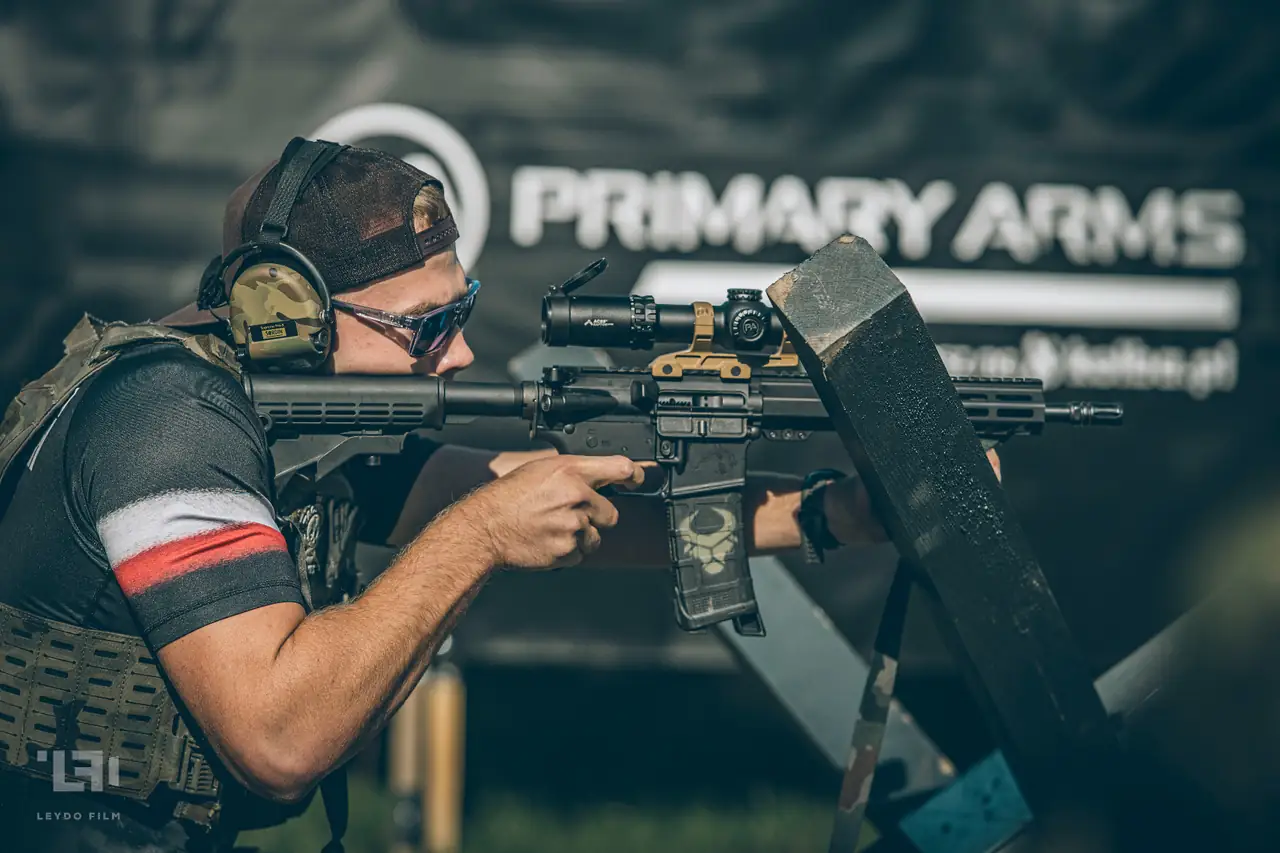
2.4.1. Firearms may not be placed on stage props (including shooting barricades) without the stage officer's (RO) permission.
2.5. It is the competitor's responsibility to understand special conditions or requirements. In case of conflicting documents, the hierarchy is:
- The WSB takes precedence over the general TTG rules
- The daily safety briefing takes precedence over the WSB
- The verbal briefing takes precedence over the WSB
2.6. It is the competitor's responsibility to report to the stage at the designated start time.
2.6.1. A late competitor may complete the stage but will receive no additional time. Unfired rounds and penalties for physical tasks will be assessed as standard.
2.7. Ballistic eye protection is mandatory for competitors, spectators and staff on the event grounds.
2.8. Hearing protection is mandatory during live fire.
2.9. No competitor or spectator may consume alcohol or intoxicating substances on the event grounds. Suspected impairment results in a Match DQ.
2.13. Awards rules:
- 3-5 competitors in a division: award for 1st place only
- 6-8 competitors: awards for 1st and 2nd place
- 9+ competitors: awards for 1st-3rd place
3.1. TTG reserves the right to revoke a title, trophy or award in the event of cheating, use of unauthorized equipment or unethical conduct.
3.2. Competitors and spectators must behave courteously and in a sporting manner. Violations may result in removal from the event.
3.6. Unsportsmanlike conduct resulting in a DQ:
- Deliberately altering a target before scoring
- Falsifying scorecards
- Changing firearm configuration without the Match Director's consent
- Threats or assault against other competitors or officials
- Interfering with other competitors while they are shooting
- Ignoring officials' instructions
- Deliberately modifying movement standards
3.8. Score arbitration procedure:
1. After scoring, competitors review their results. Issues are reported immediately.
2. The competitor must photograph their targets.
3. The Match Director reviews the dispute and issues a final decision.
3.9. After the competition ends there is a 15-minute final arbitration period. Once closed, results are FINAL.
4.1. All events are run on cold ranges.
4.2. Competitors' firearms remain unloaded except under the supervision of an official.
4.3. Firearms may only be handled and displayed in designated safety areas.
4.5. Firearms may not be loaded in a safety area.
4.6. Ammunition (including dummy rounds and snap caps) may not be handled in a safety area.
4.7. Transporting firearms between stages:
- Pistols: unloaded, in a case or holster, hammer down, magazine removed
- Rifles: unloaded, in a case or on a cart/carried on a sling muzzle up/down, with a chamber flag, magazine removed
4.8. An unsafe discharge = immediate Match DQ.
4.10. Abandoning a firearm outside a designated place (dump barrel for rifles, dump bucket or holster for pistols) = Match DQ. The "2000-foot cliff" rule — an abandoned firearm is unavailable for further use.
4.12. Breaking the 180° rule (muzzle crossing the safety plane) = Match DQ.
4.14. Engaging steel targets from an unsafe distance = Match DQ:
- Pistols: minimum 5 yards
- Rifles: minimum 40 yards
4.15. Pointing the muzzle at any part of the competitor's or another person's body (sweeping) = Match DQ.
5.1. All equipment must start and finish the match in the same condition. Modifying equipment to gain an advantage = Match DQ.
5.3. Plate carriers:
- Women: 5.4 kg (12 lbs)
- Men: 6.8 kg (15 lbs)
- Weight measured "slick" — without pouches, attachments, bladders, etc.
5.6. Ammunition:
- Pistol: 9mm Parabellum or larger
- Rifle: .223 Remington / 5.56 NATO or larger, max 3200 fps
- AK ammunition allowed, no steel core, max 3200 fps
- PROHIBITED: tracer, incendiary, armor-piercing, bimetal, steel-core/tungsten-core ammunition
- Magnets may be used to check ammunition at any time
- Power Factor: 9mm = 125PF, .40SW/.45ACP/10mm = 165PF
5.7. Firearms:
- Firearms must be of factory configuration. Prototypes are prohibited.
- Automatic firearms are allowed in semi-auto mode ONLY.
- No factory safety devices may be disabled.
- The same firearms (pistol and rifle) for the entire match, including optics.
5.8. Pistol:
- Slide-mounted red dots allowed in all divisions
- Compensators allowed
- The holster must have active retention, cover the trigger, and be worn on a belt at the waist
- Magazines: max 170mm (single stack), max 140mm (double stack)
- Calibers: 9mm, .40 S&W, .45 ACP, 10mm
5.9. Rifle:
- Bipods, tripods and support bags are PROHIBITED
- A sling is MANDATORY and must remain on the firearm for the entire match
- Compensator rule: muzzle devices directing gases in any direction other than parallel to the bore are PROHIBITED. Allowed: A2, bird cage, three/four-prong, suppressors (must remain on the firearm), blast forwarding devices (e.g. SureFire Warden)
- Drum magazines are PROHIBITED
6.1. Check-in takes place the day before the match starts. Inspection of the rifle, pistol and plate carrier.
6.1.3. Rifle muzzle devices must not vent gases to the sides. Flash hiders, suppressors and compensators fully covered by a blast-forward device are allowed; compensators and muzzle brakes that vent sideways are not. Non-compliant rifles require the muzzle device to be replaced.
6.1.5. Plate carriers are weighed "slick" — all attachments must be removed. If the weight is insufficient, the competitor must add weight.
6.2. Competitor numbers: e.g. 115 = Squad 11, lane 5.
6.4. A total of 8 stages over the weekend: 4 stages on day 1, 4 stages on day 2 (Qualifier Event).
7.1. The last assigned squad serves as athlete judges on their lanes. Failing to stay for judging = Stage DQ.
7.2. On the RO's command, competitors place their rifles in the rifle box and remove the chamber flag. They may obtain a sight picture (up to 60 seconds).
7.3. Start command: "3, 2, 1, GO!"
7.4. If a competitor does not finish within the time cap, the official reports the point at which the competitor stopped.
7.5. After the stage ends, the RO directs unloading and flagging of firearms. Competitors return to the scoring table and prepare to judge the next squad.
TTG Stages (Tactical Games Stages):
"ATHLETES ARE YOU READY? JUDGES ARE YOU READY?" — preparatory command
"3, 2, 1, GO!" — stage start
"STOP" — immediate halt (safety violation, equipment failure, dangerous situation). The competitor must stop safely and wait for instructions.
"TIME, CEASE FIRE, CEASE FIRE" — end of stage. Everyone must stop shooting, unload, and holster/flag. A shot after this command = Match DQ.
"RANGE IS CLEAR!" — you may go downrange.
Tac 2 Gun and Aggregate stages:
"MAKE READY" — the competitor prepares the firearm for the start
"ARE YOU READY?" — no response means ready
"STANDBY" — command before the start signal (1-4 seconds)
Start signal — stage start
"IF YOU ARE FINISHED, UNLOAD AND SHOW CLEAR" — unload and show the RO
"IF CLEAR HAMMER DOWN / BOLT FORWARD" — dry fire in a safe direction. No shots after this command (Match DQ for a shot).
"HOLSTER or FLAG" — holster the pistol / insert a chamber flag in the rifle
9.1. Misses: +10 second penalty for each missed shot (unless the WSB states otherwise).
9.2. Paper targets: a shot in the "hit" zone = a hit. If the "grease ring" (bullet mark) touches the outer edge of the zone line = a hit.
9.3. Steel targets: hit or miss. Miss penalty +10s. In case of doubt — the benefit goes to the competitor.
9.5. All physical and shooting tasks must be performed in accordance with the intent of the stage. Violating movement standards = time penalty.
9.6. Minimum work requirement: failure to meet it = DNF (Did Not Finish) with a score of zero. The competitor MAY continue in the remaining stages.
PCSL paper targets (2025):
- Zones: T, A, C, D
- Zones T and A = scoring area (hit)
- A shot in zone C or D = +2.5 second penalty
- A miss = +5.0 second penalty
- Brown side = pistol target
- White side = rifle target
Scoring system — timed stage:
Time (in seconds) + penalties = score. Best score = 100 pts. Others receive a percentage: (best/score) × 100.
Scoring system — AMRAP stage:
Shooting points + points for physical tasks = total. Best = 100 pts, the rest proportionally.
10.1. TTG stages use steel targets or standard paper targets.
10.2. Distances: from 3 yards to 600 yards.
10.3. All Qualifier Events use PCSL 2025 paper targets.
10.5. No-Shoot targets (penalty): marked as solid red with a black "X".
10.7. Reactive (falling) steel targets: usually one hit = neutralization, unless the WSB states otherwise.
10.8. Static steel targets: require an audible hit for neutralization.
11.1. If a target falls/is destroyed by weather BEFORE the start — the RO stops, repairs, and restarts the competitor.
If a target falls/is destroyed DURING the stage — the competitor continues and must engage the target head or base with the appropriate number of rounds.
11.1.1. Shots outside the scoring zone on paper are counted as misses.
11.1.2. Failing to engage a destroyed target = FTE (Failure To Engage) penalty.
12.1. In the Intermediate and Masters 50+ divisions the disassemble rule applies — the competitor may break down an obstacle/load and carry the elements one at a time.
12.1.1.1. The original movement standards must be preserved (overhead = overhead, farmers = farmers).
12.1.1.2. ONLY ONE ELEMENT at a time — carried repeatedly.
14.1. If a team member is disqualified, the partner may continue, but the results will not count.
14.1.2. A DQ for unsportsmanlike conduct = DQ for both team members.
14.2. Masters team: combined age of both competitors ≥ 80 years.
STAGE DQ (the competitor continues the match, stage score = 0):
- Dropping an unloaded/inert firearm
- Shooting a wooden barricade or prop on the firing line
- Unsportsmanlike conduct delaying the stage start
- Failing to stay for judging
- Preparing the firearm before the "Make Ready" command
- A second Stage DQ in the match = immediate Match DQ
MATCH DQ (full disqualification, no refund):
- Absence from the safety briefing
- Under the influence of prohibited substances
- Shooting at targets outside the competition
- Unsafe discharge
- Breaking the 180° rule
- Sweeping (pointing the muzzle at a person)
- Dropping a loaded firearm
- Using prohibited ammunition
- Shooting a steel barricade/prop
- Abandoning a firearm outside a designated place
- Engaging steel targets from an unsafe distance
- Shooting while holding a second firearm
- A shot after the "Cease Fire" command
QUICK RULES TO REMEMBER
Safety First: All events run on cold ranges. Firearms remain unloaded except under RO supervision. Any unsafe discharge results in immediate match disqualification.
180-Degree Rule: Muzzle discipline is strictly enforced. Breaking the 180-degree safety plane or pointing at any person results in match DQ.
Vest for men is 6.8kg and 5.4kg for women
Rifle muzzle devices must not vent gases to the sides. Flash hiders, suppressors and compensators fully covered by a blast-forward device are allowed; compensators and muzzle brakes that vent sideways are not.
Sling is MANDATORY on rifle on all stages
You cannot modify your belt after check-in
SCORING EXAMPLES
TIME-ONLY STAGE
Time in seconds + penalties (10s per miss) = final score. Best score = 100 points, rest proportionally.
Athlete A: Time 8:30 | Misses: 11
510s + 110s = 620s
Athlete B: Time 7:13 | Misses: 8
433s + 80s = 513s ← WINNER
Score A: (513/620)×100 = 82.74 pts
Score B: 100.00 pts
AMRAP STAGE
Shooting points + fitness points = total. Best score = 100 points, rest proportionally.
Athlete A: Shooting: 98 | Fitness: 103
Total = 201 pts ← WINNER
Athlete B: Shooting: 87 | Fitness: 105
Total = 192 pts
Score B: (192/201)×100 = 95.52 pts
Score A: 100.00 pts
MATCH DAY
CHECK-IN
Day before: rifle, pistol and plate carrier inspection.
BRIEFING
Mandatory safety briefing + stage briefings. Absence = Match DQ.
8 STAGES
4 stages per day. After finishing, you stay as athlete judge.
RESULTS
15-minute arbitration period after the last stage. Results are FINAL.
MATCH DISQUALIFICATION OFFENSES
Safety Violations
- Unsafe discharge of firearm
- Breaking 180-degree safety plane
- Dropping loaded firearm
- Pointing firearm at any person
- Using prohibited ammunition
Conduct Violations
- Alcohol or drug use at event
- Unsportsmanlike behavior
- Altering targets or equipment
- Missing safety briefings
- Shooting targets outside competition